






Article: The sale that never ends
The sale that never ends
The short answerIf a sofa is almost always 'on sale', the sale price is simply its price, and the 'was' price was never really charged. Every SUPERBA sofa has one fair price, every day.
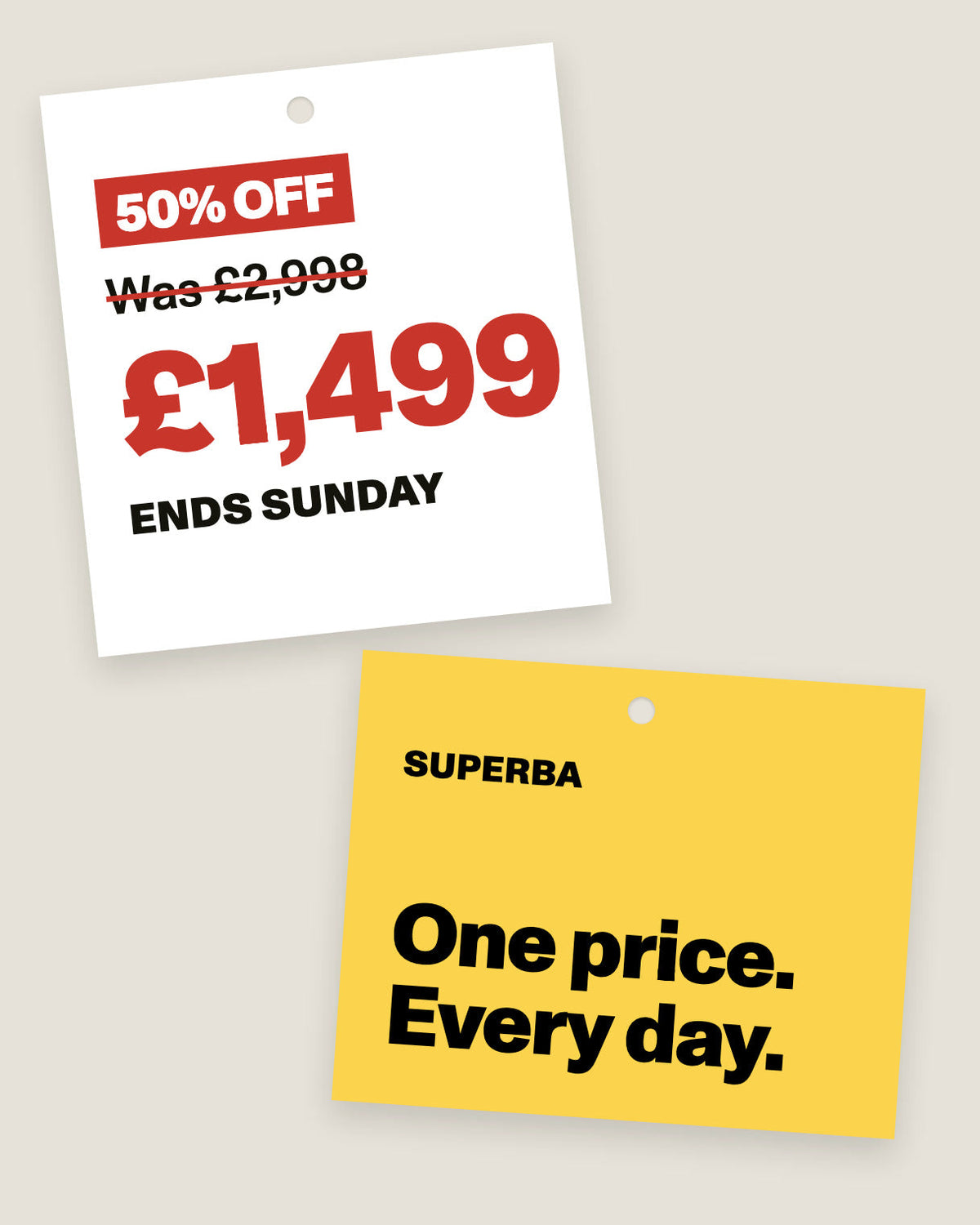
You have probably seen it. A sofa you like, a price crossed out in red, a bigger number above a smaller one, and a banner that says the offer ends on Sunday. You come back the following week and the offer is still there. It ends on Sunday again.
That is not an accident. For many retailers, the sofa sale isn't an event; it is the business model. Here is how it works, why it works so well, and why we decided a long time ago not to play.
A year in the life of a "was" price
Let's follow an imaginary sofa through twelve months. It isn't based on any real brand or product, but the pattern will look familiar.
In January it launches at £2,998. Hardly anyone buys it at that price, and that's fine: the price was never really meant to sell sofas. In February the banner goes up: 50% off, was £2,998, now £1,499. The sale ends on Sunday, then the next Sunday, then the one after. By December it has spent almost the whole year "reduced". The £2,998 was never the price. It was the backdrop that makes £1,499 look like a win.
What the tag says, and what people pay
The imaginary sofaWas £2,998, now £1,499£1,499, almost every week
A SUPERBA sofaOur priceOur price, every week
- 4weeks at the "full" priceweeks anyone was asked to pay £2,998
- 48weeks "on sale"weeks at £1,499, the price people actually pay
- 52weeks at one SUPERBA price
Seen this way, the imaginary sofa is a bargain almost all year: half price, ending Sunday.Seen this way, there is no discount at all. £1,499 is simply the price, and the "saving" was never there to begin with.
Why it works
Behavioural economists call it anchoring. The first number we see sets our sense of value, and everything after is judged against it. Show someone £2,998 and then £1,499, and £1,499 feels like a gift. Show them £1,499 on its own, and they start comparing it with other sofas instead.
Add a countdown clock and a second force kicks in: loss aversion. We feel the pain of missing a saving more than the pleasure of making one, so "ends Sunday" pushes a decision that might otherwise have taken weeks. Then come the extras: 10% off for joining the mailing list, an extra code at checkout, a "price match". Each one feels like a small victory.
For a retailer, this is a customer acquisition strategy, and an effective one. A crossed-out price gets more clicks than a plain one, a deadline converts browsers into buyers, and a discount code turns a visitor into a newsletter subscriber. The cost of all that is built into the price long before the discount takes it out again.
“A saving from a price nobody pays isn't a saving. It's a story.”
Is it allowed?
UK consumer law says a "was" price has to be genuine: a real price the product was really offered at, not a number chosen to make a discount look bigger. The Competition and Markets Authority has published principles on discount and reference pricing, and since April 2025 it can fine businesses directly for misleading pricing under the Digital Markets, Competition and Consumers Act.
Where exactly the line sits is still being argued in the courts. Our view is simpler: if you have to ask whether a discount is real, the price probably wasn't.
How to spot a real deal
-
Has it ever sold at the "was" price?
Look the sofa up a few weeks apart, or use a price-history tool. If it is always reduced, the reduction is the price.
-
Does the clock keep resetting?
A sale that ends every Sunday isn't ending. Real deadlines don't come back.
-
Is there always another code?
If every visit brings a new percentage, the starting price was set with that in mind.
-
Compare the sofa, not the percentage
Frame, filling, cover, guarantee, returns. A smaller saving on a better-made sofa is the better deal. Our sofa buying guide has the checklist.
-
Ask what you're paying for
Showrooms, middlemen and promotions all sit inside a sofa's price. The fewer of them, the more of your money goes into the sofa.
Our way: one fair price
We don't run sales. Not in January, not on Black Friday, not "this weekend only". We don't send discount codes and we don't show crossed-out prices, because we never set a price high enough to cross out.
We can do that because of how we're built. SUPERBA sofas are factory direct: handmade sofas, made to order in our own factory and sold straight to you, with no agents, distributors or retail margins in between. There is no headroom in the price for a future promotion, so there is nothing to take off. From our luxury leather sofas in Italian leather to linen and velvet, every piece is priced the same way: once, honestly, for everyone.
It means you never have to time your purchase, chase a code or wonder whether the person who bought last week paid less. Buy when you're ready. The price will be the same. You can read more on our pricing page.
Questions people ask
Why doesn't SUPERBA have a Black Friday sale?
Because our prices don't have room in them for one. We sell factory direct with no middlemen and set each price once, at what the sofa is worth. Discounting it later would mean it was too high to begin with.
Isn't a sale good for customers?
A genuine, occasional reduction can be. A permanent one usually isn't: if a sofa is almost always 'on sale', the sale price is simply its price, and the 'was' price was never really charged.
How can I tell if a discount is genuine?
Check the price over a few weeks, watch for countdowns that reset, and be wary when there is always another code. Then compare the sofas themselves: frame, filling, cover, guarantee and returns.
What is a reference price?
The 'was' or 'RRP' price shown next to a sale price. In the UK it should be a genuine price the product was actually offered at, not a figure chosen to make the saving look bigger.
Will SUPERBA prices ever change?
If our costs change, we update prices openly, for everyone, rather than as a promotion. There is no better week to buy.